Mah and Pah live down in Kings Mountain, Kentucky. That's where I done did mah growin' up, and that's where they do most o' there livin' now. Over Turkey Day, my cousin Butch done brought us a bird for the roastin' that he done hunted down the week prior. We cooked that sucker up in all kinds o' juice and wine and ate it with a side of corn puddin' ol' Aunt Sheryl and Uncle Clyde brought up from Faubush. We got to talkin' 'bout the state o' things where she lives (on a farm with her husband Clyde) and whatnot with this here talk about them's takin' away those ethanol subsidies that Clyde gits. I was tryin' ta 'splain 'bout all the learnins I been doin' at the University and how it ain't necessarily real good for the energies that ya gotta put into cookin' ethanol compared with the energies ya get back. I talked my argument real clear-like and gave all the folks round the table a good listen:
My Mah's been a schoolmarm since I was a just a babe-child-boy. But she's got herself a little garden in the back for tomaters and beans and whatnot. So she's got kinda the same relationship with the earth and whatever like Uncle Clyde do. And, well, shoot. She said it ain't right and it ain't fair that Uncle Sam gon' take away the moneys he been given to ol' Clyde all this time just cause it ain't as good as gas. Firstly, it's wrong on account of unclehood she said. And second, ain't no sense in hangin' poor Clyde out to dry like my basketball shorts when he done put so much dang work into gittin' him some land and some corn and some big machines. Ain't nothin' right about none o' that.
Pah, who ain't never seen nothin' purdy 'bout farmin' (and kinda takes to hatin' his sister's man) said that it serves him right for not helpin' him (Pah) with gittin' his local jewelry store started up. Pah's in the jewelin' business and gots all kinds o' rings and sparkly gemstones for the folks in Kings Mountain. He said he ain't never got no subsidy from Uncle Sam for his jewel store and Clyde should just be a man and quit whinin' bout them takin' 'way his precious corn juice moneys.
Now Clyde, who musta been drinkin' before we even done put Butch's turkey on a spit, got hisself a tad excited when Pah started blabberin', seein' as his acreage is at stake with the state. I saw him swearin' 'neath his breath when Pah was talkin', but he let him say his piece. Then he talked about raisin' little Butchy on them lands they got and how ain't nothin' in the world that'd make him trade all that away even without them ethanol subsidehs. I was fittin' to tell him 'bout some real smart good farmer boys like Wes Jackson and Wendell Berry, but Uncle Clyde wasn't havin' none o' that--said ol' Wendell was too dang busy writin' pansy poems to see how good the new farmin' technology was gittin'. Clyde said he done invested too dang much in his ethanol corn and ain't no way he can afford to change everything about his farmin' process in a year, or even live for that there matter, without them subsidies.
Aunt Sheryl was sittin' quiet-like for most o' the evenin', but she done hollered up when Clyde's voice was gittin' cranky and said, "Let's eat!"
So we did.
Sunday, December 5, 2010

Tuesday, November 30, 2010
Dear Doctah Sandahz:
1. In your book, A Conservationist Manifesto, you focus primarily on changes for a more sustainable life occurring on the individual/personal level. How do you feel about changes that happen in a more top-down manner? Can the type of change we need be accomplished at a government level? Or would those actions be nullified in the case of an unchanging attitudes on the individual level?
2. Do you feel that an etymological approach to complex problems (such as the one you use in the chapter "A Few Earthy Words") is always helpful? Is there ever a risk that historical definitions do more to complicate than simplify a situation?
3. For the busy-scheduled person who "doesn't have time" to start a garden or knit a sweater, is lack of time an acceptable argument for not practicing some of the tactics you advocate in your book? To what extent should we make time for sustainable practices?
4. As a appreciator of words, how do you feel about products being labeled as 'green'?
2. Do you feel that an etymological approach to complex problems (such as the one you use in the chapter "A Few Earthy Words") is always helpful? Is there ever a risk that historical definitions do more to complicate than simplify a situation?
3. For the busy-scheduled person who "doesn't have time" to start a garden or knit a sweater, is lack of time an acceptable argument for not practicing some of the tactics you advocate in your book? To what extent should we make time for sustainable practices?
4. As a appreciator of words, how do you feel about products being labeled as 'green'?
Sunday, November 7, 2010
Paper Outline
My question, very generally, is how are building codes/regulations established? I will be looking at the U.S. building codes with special attention to the regulations concerning energy, and comparing that to equivalent building policies in other developed/developing countries.
While government certification programs such as LEED are providing the incentive for building more efficient and environmentally thoughtful structures, they are just that--incentive. Building code and policy provide a legal standard to which buildings can be constructed. That said, a radical upgrade of these codes could initiate a mandatory LEED-like building sector. After hearing Thomas Friedman and Bill Brown (Director of the Office of Sustainability) speak on related topics, I feel that strict policy on a large scale has the potential to make a credible difference in unsustainable practices. By examining building regulations around the world which have radically changed what a 'to-code' building should consist of, we can start to better understand how the U.S. system might be improved.
My thesis is that building-code policy is heavily influenced by utility prices. Cheap access to electricity or clean water implores buildings to be built with lights and faucets that take full advantage of those artificially 'sweetened' prices. While an efficient water-heater or dual-flush toilette system would indeed save the extra cost of the investment and more, the prices of utilities do not honestly reflect their environmental cost and, therefore, do not have as much of an impact on sustainable construction.
Some of the sources I'll be using include the Buildings Energy Data Book, various newspaper articles, Statistics Denmark, and the International Code Council.
Firstly, defining and explaining the nature of building codes in the U.S. will be an important first step. Who is involved in the writing of the code and the administering of the code will also be important to our overall understanding of this complex procedure. Much of the complexity is derived from the fact that building code in the U.S. is set at a local or state level. While the ICC has a written 'national' building code, local and state regulations are much more often adhered to.
Next, what factors are considered when code is written will tell us about where these regulations can be changed. Proximity to fresh water would hypothetically have a severe influence on shower-head standards.
Next I will explore where building codes have taken a more sustainable turn (California, Denmark). Understanding how these standards were put in place will help to better understand how the U.S. building codes can be upgraded.
While government certification programs such as LEED are providing the incentive for building more efficient and environmentally thoughtful structures, they are just that--incentive. Building code and policy provide a legal standard to which buildings can be constructed. That said, a radical upgrade of these codes could initiate a mandatory LEED-like building sector. After hearing Thomas Friedman and Bill Brown (Director of the Office of Sustainability) speak on related topics, I feel that strict policy on a large scale has the potential to make a credible difference in unsustainable practices. By examining building regulations around the world which have radically changed what a 'to-code' building should consist of, we can start to better understand how the U.S. system might be improved.
My thesis is that building-code policy is heavily influenced by utility prices. Cheap access to electricity or clean water implores buildings to be built with lights and faucets that take full advantage of those artificially 'sweetened' prices. While an efficient water-heater or dual-flush toilette system would indeed save the extra cost of the investment and more, the prices of utilities do not honestly reflect their environmental cost and, therefore, do not have as much of an impact on sustainable construction.
Some of the sources I'll be using include the Buildings Energy Data Book, various newspaper articles, Statistics Denmark, and the International Code Council.
Firstly, defining and explaining the nature of building codes in the U.S. will be an important first step. Who is involved in the writing of the code and the administering of the code will also be important to our overall understanding of this complex procedure. Much of the complexity is derived from the fact that building code in the U.S. is set at a local or state level. While the ICC has a written 'national' building code, local and state regulations are much more often adhered to.
Next, what factors are considered when code is written will tell us about where these regulations can be changed. Proximity to fresh water would hypothetically have a severe influence on shower-head standards.
Next I will explore where building codes have taken a more sustainable turn (California, Denmark). Understanding how these standards were put in place will help to better understand how the U.S. building codes can be upgraded.
Questions for Emilie Rex and Jacqui Bauer
Emilie Rex
1. How hard was it to concentrate on your sustainability audit of Upland Brewery when the beer was free, and in what ways did that experience help you in assessing the sustainability of some of IU's buildings/departments/programs?
2. What seem to be the most effective means of getting people involved/invested in the energy challenge? Did this fall's competition seem to vary much in comparison with last spring's?
3. As a relatively new Office of Sustainability, where do you look, if you do, for role models in the field? To whom do you look when addressing a new campus issue?
Jacqui Bauer
1. As Bloomington's first Sustainability Coordinator, what do you find is most important about your job? Specifically, what sort of example are you trying to set for future Bloomington Sustainability Coordinators to come?
2. What measures are being taken to expand/better the already quite successful Hoosier to Hoosier Community Sale in August of next year?
3. How do you feel about your position's placement within the office Economic Development?
1. How hard was it to concentrate on your sustainability audit of Upland Brewery when the beer was free, and in what ways did that experience help you in assessing the sustainability of some of IU's buildings/departments/programs?
2. What seem to be the most effective means of getting people involved/invested in the energy challenge? Did this fall's competition seem to vary much in comparison with last spring's?
3. As a relatively new Office of Sustainability, where do you look, if you do, for role models in the field? To whom do you look when addressing a new campus issue?
Jacqui Bauer
1. As Bloomington's first Sustainability Coordinator, what do you find is most important about your job? Specifically, what sort of example are you trying to set for future Bloomington Sustainability Coordinators to come?
2. What measures are being taken to expand/better the already quite successful Hoosier to Hoosier Community Sale in August of next year?
3. How do you feel about your position's placement within the office Economic Development?
Monday, October 25, 2010
The Greatest of Greats
It's weird, I think, to have an impossibility for a goal. No utopia would be a utopia for all, therefore, no utopia is a sincere possibility. That said, does it make sense to work towards the unachievable? Maybe.
While realizing an actual utopia might be impossible, that doesn't mean that working towards one is a bad plan. After all, a near-utopia still sounds pretty good compared to our current situation. If we could all just work towards the same Utopian dream, we might get close and... already, I feel skeptical that everyone has the same Utopian vision. So even working towards a near-utopia might be impossible. Regardless of all these setbacks, I think that there is some merit in thinking about such hypothetical worlds, achievable or not. To find the perfect solution requires one to prioritize the most basic of needs/wants (if wants are even included), and consequently, get a better sense of what's important in life.
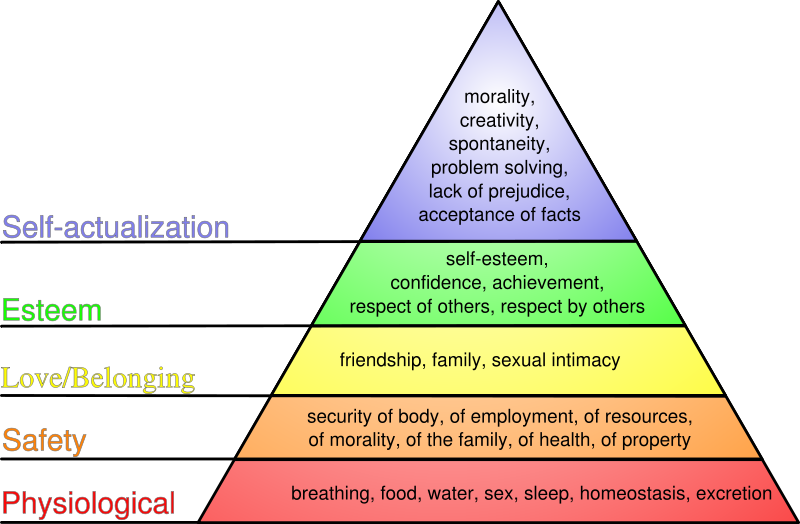
Certain basic needs such as food and water need to be addressed before all others. I've rewritten the next sentence a handful of times now, trying to decide in what quantity these items should come in--'enough'? 'plentiful'? Would an excess of food be bad? I'll stick my utopia with 'enough' food and water to subside for now. Again, prioritization is a difficult chore, but I feel like a sense of belonging is the next most important thing to have. Without it, I think there is only so much incentive we can provide ourselves. Abraham Maslow has a similar set of principles that determine basic human needs. I think that creating a utopia should use a similar set of needs as a checklist.
While realizing an actual utopia might be impossible, that doesn't mean that working towards one is a bad plan. After all, a near-utopia still sounds pretty good compared to our current situation. If we could all just work towards the same Utopian dream, we might get close and... already, I feel skeptical that everyone has the same Utopian vision. So even working towards a near-utopia might be impossible. Regardless of all these setbacks, I think that there is some merit in thinking about such hypothetical worlds, achievable or not. To find the perfect solution requires one to prioritize the most basic of needs/wants (if wants are even included), and consequently, get a better sense of what's important in life.
Certain basic needs such as food and water need to be addressed before all others. I've rewritten the next sentence a handful of times now, trying to decide in what quantity these items should come in--'enough'? 'plentiful'? Would an excess of food be bad? I'll stick my utopia with 'enough' food and water to subside for now. Again, prioritization is a difficult chore, but I feel like a sense of belonging is the next most important thing to have. Without it, I think there is only so much incentive we can provide ourselves. Abraham Maslow has a similar set of principles that determine basic human needs. I think that creating a utopia should use a similar set of needs as a checklist.
Sunday, October 3, 2010
Sanders, Part 1: [OED] 1. One who or something which sands or sprinkles with sand; one who collects sand. 2. A sand-papering machine.

So Sanders knows how to read a dictionary. Why is this important?
By using the roots of words to connect modern perceptions of words' meanings to their older counterparts, Sanders is able to make a profound statement on the environmental origin of day-to-day words. Words like 'economy' are genuinely not thought of in the sense that he demonstrates. But, to quote a modern-day youtube philosopher, "What does this meeeeeeean?" You could just as easily point out that yes, that was an older definition of the word. Now it means this. Things (including language) change. Which is certainly true. However, Sanders dos not try to negate modern definitions with the old. Instead, a bridge between two seemingly distinct terms is sought out. Sanders urges the reader to find the older meaning in today's context. The modern-day economy is, no doubt, extremely important in its ability to provide goods, services, and jobs for much of the U.S. population. However, the older sense of the word also has merit and should be appreciated for that. By pointing out how the roots of economy (house and arrange) can apply to our current need to care for the environment, Sanders makes a convincing etymological argument for sustainable practices.
This defining approach that Sanders uses is also present in his chapter on the 'Common Wealth' (two words, he specifies). Again, highlighting the origin of each word and what they mean as two parts in a whole rather than just a whole is a priority for the English professor.
For me, I like his approach. But then again, I have also chosen to study English. I find a certain aesthetics in the origins of words, more so when they can present a new twist of a word that was perhaps not seen before. However, I don't think that this bias is 1) only specific to me or 2) the only thing working for Sanders. His use of anecdote and analogy is also appealing. His personal account of Brown's Woods eventual destruction is moving through his skills as a storyteller. His redefinition of an 'ark' provides us with a mythological story as context that makes it easy to perceive other things as arks. Through an examination of language, Sanders successfully brings the precedence that environmental issues deserve to light. An exposure of what everyday words really mean (or have meant in the past) serves as a call to awareness about the extenet to which the environment really is connected with our wellbeing. Or should I say wealth....
Subscribe to:
Comments (Atom)