Mah and Pah live down in Kings Mountain, Kentucky. That's where I done did mah growin' up, and that's where they do most o' there livin' now. Over Turkey Day, my cousin Butch done brought us a bird for the roastin' that he done hunted down the week prior. We cooked that sucker up in all kinds o' juice and wine and ate it with a side of corn puddin' ol' Aunt Sheryl and Uncle Clyde brought up from Faubush. We got to talkin' 'bout the state o' things where she lives (on a farm with her husband Clyde) and whatnot with this here talk about them's takin' away those ethanol subsidies that Clyde gits. I was tryin' ta 'splain 'bout all the learnins I been doin' at the University and how it ain't necessarily real good for the energies that ya gotta put into cookin' ethanol compared with the energies ya get back. I talked my argument real clear-like and gave all the folks round the table a good listen:
My Mah's been a schoolmarm since I was a just a babe-child-boy. But she's got herself a little garden in the back for tomaters and beans and whatnot. So she's got kinda the same relationship with the earth and whatever like Uncle Clyde do. And, well, shoot. She said it ain't right and it ain't fair that Uncle Sam gon' take away the moneys he been given to ol' Clyde all this time just cause it ain't as good as gas. Firstly, it's wrong on account of unclehood she said. And second, ain't no sense in hangin' poor Clyde out to dry like my basketball shorts when he done put so much dang work into gittin' him some land and some corn and some big machines. Ain't nothin' right about none o' that.
Pah, who ain't never seen nothin' purdy 'bout farmin' (and kinda takes to hatin' his sister's man) said that it serves him right for not helpin' him (Pah) with gittin' his local jewelry store started up. Pah's in the jewelin' business and gots all kinds o' rings and sparkly gemstones for the folks in Kings Mountain. He said he ain't never got no subsidy from Uncle Sam for his jewel store and Clyde should just be a man and quit whinin' bout them takin' 'way his precious corn juice moneys.
Now Clyde, who musta been drinkin' before we even done put Butch's turkey on a spit, got hisself a tad excited when Pah started blabberin', seein' as his acreage is at stake with the state. I saw him swearin' 'neath his breath when Pah was talkin', but he let him say his piece. Then he talked about raisin' little Butchy on them lands they got and how ain't nothin' in the world that'd make him trade all that away even without them ethanol subsidehs. I was fittin' to tell him 'bout some real smart good farmer boys like Wes Jackson and Wendell Berry, but Uncle Clyde wasn't havin' none o' that--said ol' Wendell was too dang busy writin' pansy poems to see how good the new farmin' technology was gittin'. Clyde said he done invested too dang much in his ethanol corn and ain't no way he can afford to change everything about his farmin' process in a year, or even live for that there matter, without them subsidies.
Aunt Sheryl was sittin' quiet-like for most o' the evenin', but she done hollered up when Clyde's voice was gittin' cranky and said, "Let's eat!"
So we did.
Sunday, December 5, 2010

Tuesday, November 30, 2010
Dear Doctah Sandahz:
1. In your book, A Conservationist Manifesto, you focus primarily on changes for a more sustainable life occurring on the individual/personal level. How do you feel about changes that happen in a more top-down manner? Can the type of change we need be accomplished at a government level? Or would those actions be nullified in the case of an unchanging attitudes on the individual level?
2. Do you feel that an etymological approach to complex problems (such as the one you use in the chapter "A Few Earthy Words") is always helpful? Is there ever a risk that historical definitions do more to complicate than simplify a situation?
3. For the busy-scheduled person who "doesn't have time" to start a garden or knit a sweater, is lack of time an acceptable argument for not practicing some of the tactics you advocate in your book? To what extent should we make time for sustainable practices?
4. As a appreciator of words, how do you feel about products being labeled as 'green'?
2. Do you feel that an etymological approach to complex problems (such as the one you use in the chapter "A Few Earthy Words") is always helpful? Is there ever a risk that historical definitions do more to complicate than simplify a situation?
3. For the busy-scheduled person who "doesn't have time" to start a garden or knit a sweater, is lack of time an acceptable argument for not practicing some of the tactics you advocate in your book? To what extent should we make time for sustainable practices?
4. As a appreciator of words, how do you feel about products being labeled as 'green'?
Sunday, November 7, 2010
Paper Outline
My question, very generally, is how are building codes/regulations established? I will be looking at the U.S. building codes with special attention to the regulations concerning energy, and comparing that to equivalent building policies in other developed/developing countries.
While government certification programs such as LEED are providing the incentive for building more efficient and environmentally thoughtful structures, they are just that--incentive. Building code and policy provide a legal standard to which buildings can be constructed. That said, a radical upgrade of these codes could initiate a mandatory LEED-like building sector. After hearing Thomas Friedman and Bill Brown (Director of the Office of Sustainability) speak on related topics, I feel that strict policy on a large scale has the potential to make a credible difference in unsustainable practices. By examining building regulations around the world which have radically changed what a 'to-code' building should consist of, we can start to better understand how the U.S. system might be improved.
My thesis is that building-code policy is heavily influenced by utility prices. Cheap access to electricity or clean water implores buildings to be built with lights and faucets that take full advantage of those artificially 'sweetened' prices. While an efficient water-heater or dual-flush toilette system would indeed save the extra cost of the investment and more, the prices of utilities do not honestly reflect their environmental cost and, therefore, do not have as much of an impact on sustainable construction.
Some of the sources I'll be using include the Buildings Energy Data Book, various newspaper articles, Statistics Denmark, and the International Code Council.
Firstly, defining and explaining the nature of building codes in the U.S. will be an important first step. Who is involved in the writing of the code and the administering of the code will also be important to our overall understanding of this complex procedure. Much of the complexity is derived from the fact that building code in the U.S. is set at a local or state level. While the ICC has a written 'national' building code, local and state regulations are much more often adhered to.
Next, what factors are considered when code is written will tell us about where these regulations can be changed. Proximity to fresh water would hypothetically have a severe influence on shower-head standards.
Next I will explore where building codes have taken a more sustainable turn (California, Denmark). Understanding how these standards were put in place will help to better understand how the U.S. building codes can be upgraded.
While government certification programs such as LEED are providing the incentive for building more efficient and environmentally thoughtful structures, they are just that--incentive. Building code and policy provide a legal standard to which buildings can be constructed. That said, a radical upgrade of these codes could initiate a mandatory LEED-like building sector. After hearing Thomas Friedman and Bill Brown (Director of the Office of Sustainability) speak on related topics, I feel that strict policy on a large scale has the potential to make a credible difference in unsustainable practices. By examining building regulations around the world which have radically changed what a 'to-code' building should consist of, we can start to better understand how the U.S. system might be improved.
My thesis is that building-code policy is heavily influenced by utility prices. Cheap access to electricity or clean water implores buildings to be built with lights and faucets that take full advantage of those artificially 'sweetened' prices. While an efficient water-heater or dual-flush toilette system would indeed save the extra cost of the investment and more, the prices of utilities do not honestly reflect their environmental cost and, therefore, do not have as much of an impact on sustainable construction.
Some of the sources I'll be using include the Buildings Energy Data Book, various newspaper articles, Statistics Denmark, and the International Code Council.
Firstly, defining and explaining the nature of building codes in the U.S. will be an important first step. Who is involved in the writing of the code and the administering of the code will also be important to our overall understanding of this complex procedure. Much of the complexity is derived from the fact that building code in the U.S. is set at a local or state level. While the ICC has a written 'national' building code, local and state regulations are much more often adhered to.
Next, what factors are considered when code is written will tell us about where these regulations can be changed. Proximity to fresh water would hypothetically have a severe influence on shower-head standards.
Next I will explore where building codes have taken a more sustainable turn (California, Denmark). Understanding how these standards were put in place will help to better understand how the U.S. building codes can be upgraded.
Questions for Emilie Rex and Jacqui Bauer
Emilie Rex
1. How hard was it to concentrate on your sustainability audit of Upland Brewery when the beer was free, and in what ways did that experience help you in assessing the sustainability of some of IU's buildings/departments/programs?
2. What seem to be the most effective means of getting people involved/invested in the energy challenge? Did this fall's competition seem to vary much in comparison with last spring's?
3. As a relatively new Office of Sustainability, where do you look, if you do, for role models in the field? To whom do you look when addressing a new campus issue?
Jacqui Bauer
1. As Bloomington's first Sustainability Coordinator, what do you find is most important about your job? Specifically, what sort of example are you trying to set for future Bloomington Sustainability Coordinators to come?
2. What measures are being taken to expand/better the already quite successful Hoosier to Hoosier Community Sale in August of next year?
3. How do you feel about your position's placement within the office Economic Development?
1. How hard was it to concentrate on your sustainability audit of Upland Brewery when the beer was free, and in what ways did that experience help you in assessing the sustainability of some of IU's buildings/departments/programs?
2. What seem to be the most effective means of getting people involved/invested in the energy challenge? Did this fall's competition seem to vary much in comparison with last spring's?
3. As a relatively new Office of Sustainability, where do you look, if you do, for role models in the field? To whom do you look when addressing a new campus issue?
Jacqui Bauer
1. As Bloomington's first Sustainability Coordinator, what do you find is most important about your job? Specifically, what sort of example are you trying to set for future Bloomington Sustainability Coordinators to come?
2. What measures are being taken to expand/better the already quite successful Hoosier to Hoosier Community Sale in August of next year?
3. How do you feel about your position's placement within the office Economic Development?
Monday, October 25, 2010
The Greatest of Greats
It's weird, I think, to have an impossibility for a goal. No utopia would be a utopia for all, therefore, no utopia is a sincere possibility. That said, does it make sense to work towards the unachievable? Maybe.
While realizing an actual utopia might be impossible, that doesn't mean that working towards one is a bad plan. After all, a near-utopia still sounds pretty good compared to our current situation. If we could all just work towards the same Utopian dream, we might get close and... already, I feel skeptical that everyone has the same Utopian vision. So even working towards a near-utopia might be impossible. Regardless of all these setbacks, I think that there is some merit in thinking about such hypothetical worlds, achievable or not. To find the perfect solution requires one to prioritize the most basic of needs/wants (if wants are even included), and consequently, get a better sense of what's important in life.
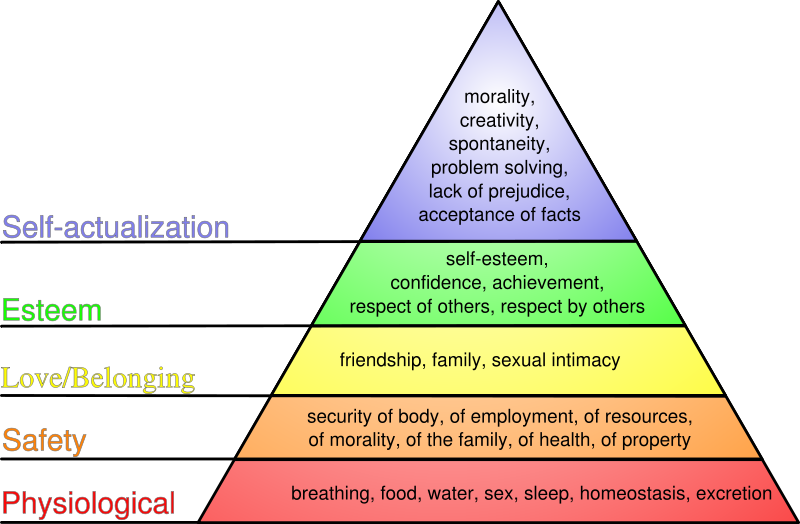
Certain basic needs such as food and water need to be addressed before all others. I've rewritten the next sentence a handful of times now, trying to decide in what quantity these items should come in--'enough'? 'plentiful'? Would an excess of food be bad? I'll stick my utopia with 'enough' food and water to subside for now. Again, prioritization is a difficult chore, but I feel like a sense of belonging is the next most important thing to have. Without it, I think there is only so much incentive we can provide ourselves. Abraham Maslow has a similar set of principles that determine basic human needs. I think that creating a utopia should use a similar set of needs as a checklist.
While realizing an actual utopia might be impossible, that doesn't mean that working towards one is a bad plan. After all, a near-utopia still sounds pretty good compared to our current situation. If we could all just work towards the same Utopian dream, we might get close and... already, I feel skeptical that everyone has the same Utopian vision. So even working towards a near-utopia might be impossible. Regardless of all these setbacks, I think that there is some merit in thinking about such hypothetical worlds, achievable or not. To find the perfect solution requires one to prioritize the most basic of needs/wants (if wants are even included), and consequently, get a better sense of what's important in life.
Certain basic needs such as food and water need to be addressed before all others. I've rewritten the next sentence a handful of times now, trying to decide in what quantity these items should come in--'enough'? 'plentiful'? Would an excess of food be bad? I'll stick my utopia with 'enough' food and water to subside for now. Again, prioritization is a difficult chore, but I feel like a sense of belonging is the next most important thing to have. Without it, I think there is only so much incentive we can provide ourselves. Abraham Maslow has a similar set of principles that determine basic human needs. I think that creating a utopia should use a similar set of needs as a checklist.
Sunday, October 3, 2010
Sanders, Part 1: [OED] 1. One who or something which sands or sprinkles with sand; one who collects sand. 2. A sand-papering machine.

So Sanders knows how to read a dictionary. Why is this important?
By using the roots of words to connect modern perceptions of words' meanings to their older counterparts, Sanders is able to make a profound statement on the environmental origin of day-to-day words. Words like 'economy' are genuinely not thought of in the sense that he demonstrates. But, to quote a modern-day youtube philosopher, "What does this meeeeeeean?" You could just as easily point out that yes, that was an older definition of the word. Now it means this. Things (including language) change. Which is certainly true. However, Sanders dos not try to negate modern definitions with the old. Instead, a bridge between two seemingly distinct terms is sought out. Sanders urges the reader to find the older meaning in today's context. The modern-day economy is, no doubt, extremely important in its ability to provide goods, services, and jobs for much of the U.S. population. However, the older sense of the word also has merit and should be appreciated for that. By pointing out how the roots of economy (house and arrange) can apply to our current need to care for the environment, Sanders makes a convincing etymological argument for sustainable practices.
This defining approach that Sanders uses is also present in his chapter on the 'Common Wealth' (two words, he specifies). Again, highlighting the origin of each word and what they mean as two parts in a whole rather than just a whole is a priority for the English professor.
For me, I like his approach. But then again, I have also chosen to study English. I find a certain aesthetics in the origins of words, more so when they can present a new twist of a word that was perhaps not seen before. However, I don't think that this bias is 1) only specific to me or 2) the only thing working for Sanders. His use of anecdote and analogy is also appealing. His personal account of Brown's Woods eventual destruction is moving through his skills as a storyteller. His redefinition of an 'ark' provides us with a mythological story as context that makes it easy to perceive other things as arks. Through an examination of language, Sanders successfully brings the precedence that environmental issues deserve to light. An exposure of what everyday words really mean (or have meant in the past) serves as a call to awareness about the extenet to which the environment really is connected with our wellbeing. Or should I say wealth....
Thursday, September 30, 2010
Questions For Doc Brabs
Dear Doctah,
1). What are the pros and cons of putting scientific research/findings into layman's terms? An obvious push for transparency would help mitigate expert-amateur tensions over the availability of technical knowledge, but at the potential cost of "dumbed down" information that could easily be misinterpreted and blown out of proportion. What is a safe way to ease the gap between those who know, and those how lack the technical training to 'know' in the same way, but are interested none-the-less?
2). As you explained in class, certain scientific data requires a "trick" or tweak before it can be accurately graphed. While you made it quite clear what had happened and been misinterpreted in the Climategate scandal, why did the scientists not explain more thoroughly what happened? From what I read, their comments on the subject maintained a level of generality that, when given their specific predicament concerning comments about a particular data set, was simply not useful for an audience that wanted significant and relevant answers for the 'scandal' at hand. Are there legitimate situations in which a scientist might very much like to withhold information from the public?
3). What on earth is a 'Q'?
4). A plan to build geothermal infrastructure has recently been invested in at Ball State University. While the investment costs are monumental (upwards of $30 million for two separate multi-year steps), 1-2 million dollars are estimated to be saved each year as a result. Does IU have the potential for an green investment of this size? Does it even make sense to? While Ball State is roughly half the size IU (student population), what can IU learn from Ball State's profound move towards a greener campus?
5). You posed this question to us, but I'd like to know your answer as well: To what extent do you believe scientists have the right to suggest policy measures, if any?
6). In regards to combating climate change, what are some of the worst things we could do? The best? As an individual? A country? A globe?
7). How awesome is Bill Nye on a scale of 1-1000? (Please note any "tricks" used if your answer includes a graph)
1). What are the pros and cons of putting scientific research/findings into layman's terms? An obvious push for transparency would help mitigate expert-amateur tensions over the availability of technical knowledge, but at the potential cost of "dumbed down" information that could easily be misinterpreted and blown out of proportion. What is a safe way to ease the gap between those who know, and those how lack the technical training to 'know' in the same way, but are interested none-the-less?
2). As you explained in class, certain scientific data requires a "trick" or tweak before it can be accurately graphed. While you made it quite clear what had happened and been misinterpreted in the Climategate scandal, why did the scientists not explain more thoroughly what happened? From what I read, their comments on the subject maintained a level of generality that, when given their specific predicament concerning comments about a particular data set, was simply not useful for an audience that wanted significant and relevant answers for the 'scandal' at hand. Are there legitimate situations in which a scientist might very much like to withhold information from the public?
3). What on earth is a 'Q'?
4). A plan to build geothermal infrastructure has recently been invested in at Ball State University. While the investment costs are monumental (upwards of $30 million for two separate multi-year steps), 1-2 million dollars are estimated to be saved each year as a result. Does IU have the potential for an green investment of this size? Does it even make sense to? While Ball State is roughly half the size IU (student population), what can IU learn from Ball State's profound move towards a greener campus?
5). You posed this question to us, but I'd like to know your answer as well: To what extent do you believe scientists have the right to suggest policy measures, if any?
6). In regards to combating climate change, what are some of the worst things we could do? The best? As an individual? A country? A globe?
7). How awesome is Bill Nye on a scale of 1-1000? (Please note any "tricks" used if your answer includes a graph)
Tuesday, September 28, 2010
The Freshest
Recycle greatness. Make more greatness.
The Hood Internet - Billie "Wildcat" Jean (Michael Jackson x Ratatat) by hoodinternet
The Hood Internet - Billie "Wildcat" Jean (Michael Jackson x Ratatat) by hoodinternet
Obama's Promises, Actions, and Problems of Tomorrow
I remember being skeptical of the skeptics when the Obama fervor was at its fever pitch. Discussions on the infectious Obamaism permeated most of my classes at one point or another, and at times, his long list of promises would be criticized by one or two of the students in class who hadn’t become completely overrun with feelings of “Hope” and “Change.” But they couldn’t be right, I thought. This was my freshman year at college which, already accented with so much other newness, seemed like the perfect environment for this inspirational rhetoric and ideology to really make some ground on big issues like climate change and healthcare. This shit was real. Real like Wheaties or Chuck Norris. Real enough to grab hold of that ever-elusive place called Washington and really shake things up. And while all of these things provided dramatic and effective fodder for speeches and rallies and broad, sweeping, unanimously approved promises on nothing in particular, they did not provide a sincere structure or plan for these dreams to become reality.
Learning about the extreme complexities of politics in the United States has made me much more attuned to the realistic capabilities a candidate might possess. Even more so, it has shown me that, where a candidate or elected official may even have power to change something, there are various other factors that come into play first, before effective policy can even be thought about. That said, I certainly should be more sympathetic with Obama’s steady shifting on issues that, had he remained stagnant and entrenched in a more liberal ideology, could potentially have been detrimental to his political career as president. However, I feel so strongly that radical change is needed as soon as possible that these are no longer valid excuses for any form of a less-than-go-getter attitude.
Having just returned from a lecture presented by Dave Rollo, a member of the City Council and Bloomington Peak Oil Task Force which recently put out a report on the eminence of quickly approaching energy shortages, I feel that the severity and scope with which peak oil will affect our social, economic, and cultural lives deems it a top priority for Obama as well as the entire country, continent, and world. As the report extensively shows, along with various other credible sources such as ASPO, the German military, and U.S. Military, peak oil is a reality that needs to be dealt with now, not a theory to be reflected on tomorrow. I cannot express enough just how far reaching and detrimental this phenomenon can potentially be if we do not start preparing ourselves immediately. Sustainable resource developments, although helpful to a degree, have nowhere near the extreme energy producing power that natural oil does. Even dirty energy producers (while inevitably doomed to the same finite fate) such as coal and natural gas have nowhere near the energy capacity that our current globe demands.
Monday, September 27, 2010
The Importance of Government Regulation, Education, and Mythical Beings' Civil Rights
Does the government have a right to regulate environmental matters? Yes. Here’s why: Let’s suppose I’m a werewolf. But I’m not some newby werewolf who’s still scared of self-mutilation or destroying my home or cat or wife. I’ve gotten used to my hairy sheep-eating ways and have figured out a systematically pleasing way to go about a somewhat normal life with the exception of these predictable lunar-driven tantrums. Let’s assume that I’ve even grown fond of my time alone in this altered state. I find the destruction of windmills and ogre huts to be quite pleasing—cathartic even. So let’s say there’s some guy or wizard or lake monster made from burning coal and toxic waste that, by the virtue of his lifestyle, is constantly producing thick and pungent smog which permeates the neighborhood. Having not cleverly inspected the surrounding residential area before building our homes, it just so happens that we all live in a cramped valley surrounded by towering cliffs and mountains and spikes and eternal flames which not only presents problems for our own transitory desires, but for the smogalicious soot-sauce as well.
I digress. Let’s suppose that this constant production of soot and dirt and socialism eventually, having no real where to go, blocks out the moon. Now I, being the old and cranky werewolf that I am, profoundly set in my ways and walks of werewolf life, feel particularly put off by the absence of this moon seeing as it prevents me from partaking in what has become a fundamental process of my life. Without access to the full moon, I have been stripped of my right as a werewolf to act and behave like the mythological beast that I am every 29.5 days. Government regulatory action is necessary in order to not only clean up the airspace around me (a claim that would currently fall under ‘public nuisance’), but to prevent similar situations from torturing other civilian werewolves around middle earth.
In this instance, preventative regulatory measures are the more important of the two options. While cleanup of a salient problem may provide a promisingly green image for the centerfold policy at hand, it will not necessarily deter others from producing similarly invasive clouds of anti-joy. It is important to note that, while the public nuisance issue may only have become salient after an individual’s experience with one or more effects of environmentally unfriendly energy or potion production, the living pleasure of this single person (or werewolf) is just a scaled down version of what could potentially be a universal problem. In order to combat this government intervention needs to concentrate on two fronts: education and strict regulation.
Of the latter, what is implemented today is usually watered down policy that, after running the lobbyist gamete, does not sincerely or seriously provide real changes within the industries it is attempting to regulate. Stricter measures that are truly enforced need to be legislated by congress. Obviously, there are many who are against this idea. Our current media-fed ideology is that there is no limit to what we can produce, consume, or fix. But, as Scott Sanders points out in A Conservationist Manifesto, that is clearly not the case. Using mere population growth as an example, an infinite trajectory is not a possible reality for humanity on this earth. Neither the resources nor the space are available. With government legislation, an attempt to wane this rampant growth (which is present in unsustainable economic practices as well as population) might seem less objectionable when presented with the eventual fail-safe that the Earth has in place: the end of humanity.
I am not usually one to advocate a doomsday scenario. I would much prefer not to delve in such pessimistic thoughts. However, as the science shows us again and again, unless significant and sustained changes are made in our lifestyles, our predicted future on Earth is a very bleak one indeed. While legislated regulatory actions could help jumpstart a greener environment for all, significant changes in individual choices and mentality are necessary in order for these practices and others like it to be sustained. As much of our deep values and belief systems are somewhat determined by our experiences as children (e.g. parent party affiliation), it would be ignorant of us to ignore such a critical period in which a generation of potential good stewards could be taught the natural beauty and importance of our environment.
Monday, September 6, 2010
Jolly Green Problems
To be honest, I am usually not aware of major political decisions that are 'green' or, for that matter, some other shade. My political affiliations regarding the environment are unclear to me because I don't honestly know what a lot of policy on the subject consists of or who is responsible for its existence. But my stance on political issues that I am aware of (although not pertaining to environmental management) is generally a more liberal and democratic one. For me, this means that I tend to value the rights of the individual more than those of the group (however I am uncertain as to how this mentality will hold up with issues of the environment). For example, my very basic understanding of the Patriot Act left me feeling upset that individual freedoms to privacy were being violated by government officials. Other typically defining issues such as same-sex marriage and the death penalty also demonstrate a more democratically charged ideology--'for' and 'against' respectively. Much of this, as we mentioned in class, is certainly due, in part, to my own parents' ideologies (which mirror my own in these examples).
My economic perspective of things (broad though it is not) tends to also be more liberally inclined. By this I mean that larger economic issues at hand like socialized health-care make me say "Hell yeah!", but only because it seems like a good idea, not because I know the specific economic outcomes of such a financially demanding program. My economic view on health-care is driven by a very un-econmic idea that those in need who cannot help themselves, should be helped, and I suppose I don't think much further than that.
When initially enrolling in this course, I did not foresee a lot of opportunities for an ecocentric view of the environment to conflict with my upbringing. I figured that buying clothes made from grass and soybeans while simultaneously not dumping buckets of box-fans and computer parts into the ocean would not mutually exclude my previous liberal sentiments. However, I am quickly seeing that things are not quite that simple.
From the various environmental philosophies that we have covered in assigned readings and class, I feel a certain want to have an ecocentric or holistic view of the environment. It seems admirable and poetic even to feel this sort of Captain-Planet-connection with the world and its smorgasbord of life as equal beings and parts of a whole unit. But I can't stop myself from thinking that saving a baby instead of a head of lettuce or platypus is a good idea. Every time. All of the time. That said, I suppose that my feelings towards the environment come second to human life. However, I also realize that human survival is dependant on an environment that functions similarly to the way it does today. So even if our investments are based in the human race's existence, our interactions with the environment have implications for future generations of human life. For example, respect for the ozone layer can very easily be manifested in the helpful duties that the ozone layer undertakes in order to keep humans safe, like filtering the sun's rays so that humans aren't all zapped with cancer and super-peely skin (although, to be fair, both of these conditions still exist, albeit at a much slower rate). Not that prolonging the human race is the only reason for not wanting to destroy the ozone. I'm sure that there is some seriously beautiful scientific shit going on with those UV rays that some people understand and love and would hate to see destroyed.
For this reason I am uncertain about a purely anthropocentric philosophy if it is one that only takes humans into account at the present. The Cornucopian theory that banks itself on human intuition and miraculous scientific discovery is not only ludicrous, but also allows for an extremely large burden to be lifted, heaved, and dropped on the shoulders of a nameless future. Believing in equality in the present should not exclude an attempt to provide the same for the future. That said, I do not agree with an over-investment in the human race's power to thrive at the expense of the environment because of the implications these changes may or will have for future generations to come. Although it is easy to be caught up in the 'here' and 'now' of the moment, I am hopeful that careful consideration of our past's involvement in our own existence will drive us to be more thoughtful and compassionate about the sort of world we leave behind for those next in line.
My economic perspective of things (broad though it is not) tends to also be more liberally inclined. By this I mean that larger economic issues at hand like socialized health-care make me say "Hell yeah!", but only because it seems like a good idea, not because I know the specific economic outcomes of such a financially demanding program. My economic view on health-care is driven by a very un-econmic idea that those in need who cannot help themselves, should be helped, and I suppose I don't think much further than that.
When initially enrolling in this course, I did not foresee a lot of opportunities for an ecocentric view of the environment to conflict with my upbringing. I figured that buying clothes made from grass and soybeans while simultaneously not dumping buckets of box-fans and computer parts into the ocean would not mutually exclude my previous liberal sentiments. However, I am quickly seeing that things are not quite that simple.
From the various environmental philosophies that we have covered in assigned readings and class, I feel a certain want to have an ecocentric or holistic view of the environment. It seems admirable and poetic even to feel this sort of Captain-Planet-connection with the world and its smorgasbord of life as equal beings and parts of a whole unit. But I can't stop myself from thinking that saving a baby instead of a head of lettuce or platypus is a good idea. Every time. All of the time. That said, I suppose that my feelings towards the environment come second to human life. However, I also realize that human survival is dependant on an environment that functions similarly to the way it does today. So even if our investments are based in the human race's existence, our interactions with the environment have implications for future generations of human life. For example, respect for the ozone layer can very easily be manifested in the helpful duties that the ozone layer undertakes in order to keep humans safe, like filtering the sun's rays so that humans aren't all zapped with cancer and super-peely skin (although, to be fair, both of these conditions still exist, albeit at a much slower rate). Not that prolonging the human race is the only reason for not wanting to destroy the ozone. I'm sure that there is some seriously beautiful scientific shit going on with those UV rays that some people understand and love and would hate to see destroyed.
For this reason I am uncertain about a purely anthropocentric philosophy if it is one that only takes humans into account at the present. The Cornucopian theory that banks itself on human intuition and miraculous scientific discovery is not only ludicrous, but also allows for an extremely large burden to be lifted, heaved, and dropped on the shoulders of a nameless future. Believing in equality in the present should not exclude an attempt to provide the same for the future. That said, I do not agree with an over-investment in the human race's power to thrive at the expense of the environment because of the implications these changes may or will have for future generations to come. Although it is easy to be caught up in the 'here' and 'now' of the moment, I am hopeful that careful consideration of our past's involvement in our own existence will drive us to be more thoughtful and compassionate about the sort of world we leave behind for those next in line.
Subscribe to:
Comments (Atom)