It's weird, I think, to have an impossibility for a goal. No utopia would be a utopia for all, therefore, no utopia is a sincere possibility. That said, does it make sense to work towards the unachievable? Maybe.
While realizing an actual utopia might be impossible, that doesn't mean that working towards one is a bad plan. After all, a near-utopia still sounds pretty good compared to our current situation. If we could all just work towards the same Utopian dream, we might get close and... already, I feel skeptical that everyone has the same Utopian vision. So even working towards a near-utopia might be impossible. Regardless of all these setbacks, I think that there is some merit in thinking about such hypothetical worlds, achievable or not. To find the perfect solution requires one to prioritize the most basic of needs/wants (if wants are even included), and consequently, get a better sense of what's important in life.
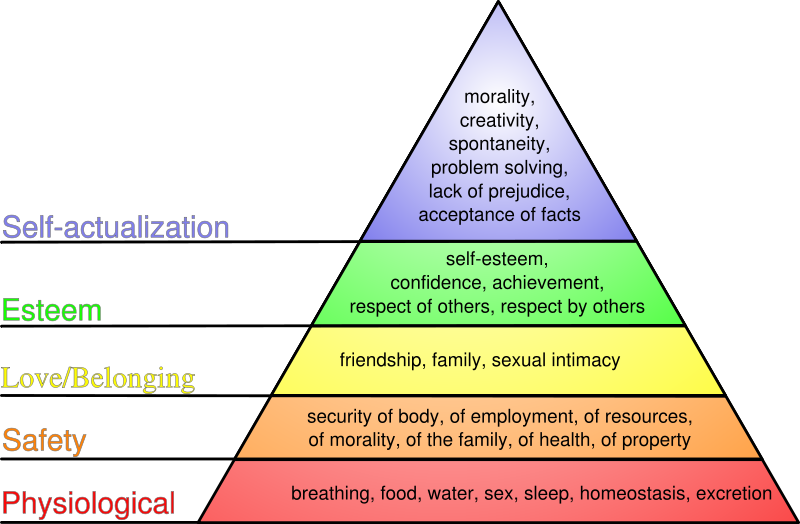
Certain basic needs such as food and water need to be addressed before all others. I've rewritten the next sentence a handful of times now, trying to decide in what quantity these items should come in--'enough'? 'plentiful'? Would an excess of food be bad? I'll stick my utopia with 'enough' food and water to subside for now. Again, prioritization is a difficult chore, but I feel like a sense of belonging is the next most important thing to have. Without it, I think there is only so much incentive we can provide ourselves. Abraham Maslow has a similar set of principles that determine basic human needs. I think that creating a utopia should use a similar set of needs as a checklist.
Monday, October 25, 2010

Sunday, October 3, 2010
Sanders, Part 1: [OED] 1. One who or something which sands or sprinkles with sand; one who collects sand. 2. A sand-papering machine.

So Sanders knows how to read a dictionary. Why is this important?
By using the roots of words to connect modern perceptions of words' meanings to their older counterparts, Sanders is able to make a profound statement on the environmental origin of day-to-day words. Words like 'economy' are genuinely not thought of in the sense that he demonstrates. But, to quote a modern-day youtube philosopher, "What does this meeeeeeean?" You could just as easily point out that yes, that was an older definition of the word. Now it means this. Things (including language) change. Which is certainly true. However, Sanders dos not try to negate modern definitions with the old. Instead, a bridge between two seemingly distinct terms is sought out. Sanders urges the reader to find the older meaning in today's context. The modern-day economy is, no doubt, extremely important in its ability to provide goods, services, and jobs for much of the U.S. population. However, the older sense of the word also has merit and should be appreciated for that. By pointing out how the roots of economy (house and arrange) can apply to our current need to care for the environment, Sanders makes a convincing etymological argument for sustainable practices.
This defining approach that Sanders uses is also present in his chapter on the 'Common Wealth' (two words, he specifies). Again, highlighting the origin of each word and what they mean as two parts in a whole rather than just a whole is a priority for the English professor.
For me, I like his approach. But then again, I have also chosen to study English. I find a certain aesthetics in the origins of words, more so when they can present a new twist of a word that was perhaps not seen before. However, I don't think that this bias is 1) only specific to me or 2) the only thing working for Sanders. His use of anecdote and analogy is also appealing. His personal account of Brown's Woods eventual destruction is moving through his skills as a storyteller. His redefinition of an 'ark' provides us with a mythological story as context that makes it easy to perceive other things as arks. Through an examination of language, Sanders successfully brings the precedence that environmental issues deserve to light. An exposure of what everyday words really mean (or have meant in the past) serves as a call to awareness about the extenet to which the environment really is connected with our wellbeing. Or should I say wealth....
Subscribe to:
Comments (Atom)